FILE DEPT

Field Report Archive

Private Skeptical Evidence Corpus

← Back to Case Files

Cryptid
Evidence Dossier

Patterson-Gimlin Film

Evidence Dossier: A record proves that a statement, transfer, examination, or result was documented. It does not automatically prove the anomalous interpretation attached to it.
1967-10-20
Bluff Creek, California, USA
8/10
6/10
Roger Patterson and Bob Gimlin filmed an unidentified, hair-covered biped at Bluff Creek on October 20, 1967, and attributed it to Bigfoot.
Strong evidence that the film exists and that Patterson and Gimlin publicly made the claim immediately afterward. The subject’s identity remains unresolved because the original camera film is unavailable for direct examination, surviving public copies are derivative, physical track evidence has an incomplete custody record, and later analyses reach disputed conclusions.

Investigative Assessments

"The reported claim remains worth testing against the record: Roger Patterson and Bob Gimlin filmed an unidentified, hair-covered biped at Bluff Creek on October 20, 1967, and attributed it to Bigfoot. The strongest documented reasons to keep the file open are: Patterson-Gimlin Complete Reel Reference Copy: The reel contains the moving subject sequence and surrounding Bluff Creek footage attributed to Patterson’s 1967 roll.; Stabilized Patterson-Gimlin Subject Sequence: It makes the subject’s gait and turn toward the camera easier to inspect.. Key unresolved lead: Where is the original camera film, and can it be independently examined with a documented chain of custody?"
"Evidentiary limitations: Strong evidence that the film exists and that Patterson and Gimlin publicly made the claim immediately afterward. The subject’s identity remains unresolved because the original camera film is unavailable for direct examination, surviving public copies are derivative, physical track evidence has an incomplete custody record, and later analyses reach disputed conclusions. Note that: Patterson-Gimlin Complete Reel Reference Copy fails to support: It does not establish that the subject is nonhuman, preserve original-film resolution, or provide a complete generation and processing history.; Stabilized Patterson-Gimlin Subject Sequence fails to support: It does not preserve original framing, camera motion, native resolution, or prove the accuracy of the stabilization transform.. Documented contradiction: The exact camera frame rate is disputed, materially changing gait and speed calculations. Leading conventional hypothesis: A human performer wearing a custom fur suit."

Case Summary

On October 20, 1967, Roger Patterson and Bob Gimlin said they encountered and filmed a large, hair-covered biped at Bluff Creek in Northern California. The surviving public reference copies show the film, while contemporary newspaper reports preserve Patterson and Gimlin’s earliest published account. Later analyses dispute frame rate, scale, anatomy, film generation, and whether the subject was biological or a person in a suit.

Evidence Locker

8 inspectable evidence items. Claims and source findings are kept separate.

Mobile-compatible H.264 MP4 transcode of a derivative public film reference copy Local copy hash-verified

Patterson-Gimlin Complete Reel Reference Copy

Analyst rating: Essential visual evidence, but a low-resolution public derivative rather than the missing original camera film.

“Visual record: the reference reel includes wooded and creek footage followed by the distant, hair-covered bipedal subject sequence.”
Record location00:00 to 03:28; subject appears within the reel
Evidence classMoving-image primary evidence, derivative public copy
Relationship to claimThis is the central recorded artifact underlying the case claim.
Authenticity assessmentHigh confidence that this file is the widely circulated Patterson-Gimlin reference reel. Low confidence that it reproduces every property of the missing original camera film.
What this supportsThe reel contains the moving subject sequence and surrounding Bluff Creek footage attributed to Patterson’s 1967 roll.
What it does not supportIt does not establish that the subject is nonhuman, preserve original-film resolution, or provide a complete generation and processing history.
ProvenanceA 3 minute 28 second public reference copy hosted by Wikimedia Commons and sourced there to Internet Archive item CompletePatterson-gimlinBigfootFilm. Commons labels the file public domain under PD-US-no-notice. The Casebook serves a locally generated H.264 MP4 compatibility transcode of the cited Commons WebM.
Chain of custodyRoger Patterson film -> unknown intermediate copy history -> Internet Archive upload -> Wikimedia Commons VP9 WebM -> Casebook H.264 MP4 compatibility transcode. The original camera film and several intermediate generations are not represented.
Mobile-compatible H.264/AAC MP4 transcode of a stabilized derivative Local copy hash-verified

Stabilized Patterson-Gimlin Subject Sequence

Analyst rating: Useful for viewing body motion, but stabilization and scaling are interpretive transformations.

“Visual derivative: the subject walks across frame and turns its upper body and head toward the camera.”
Record location00:00 to 00:10
Evidence classProcessed moving-image derivative
Relationship to claimA viewing aid derived from the primary film, not an independent observation.
Authenticity assessmentHigh confidence that it is a derivative of the familiar subject sequence. Transform accuracy has not been independently reconstructed here.
What this supportsIt makes the subject’s gait and turn toward the camera easier to inspect.
What it does not supportIt does not preserve original framing, camera motion, native resolution, or prove the accuracy of the stabilization transform.
ProvenanceA 10 second stabilized derivative hosted by Wikimedia Commons and credited to a public video conversion. Commons labels it public domain under PD-US-no-notice. The Casebook serves a locally generated H.264 MP4 compatibility transcode of the cited Commons WebM.
Chain of custodyPatterson film copy -> digital crop, scale, and stabilization -> Wikimedia Commons VP9/Opus WebM -> Casebook H.264/AAC MP4 compatibility transcode.
Contemporary newspaper scan Local copy hash-verified

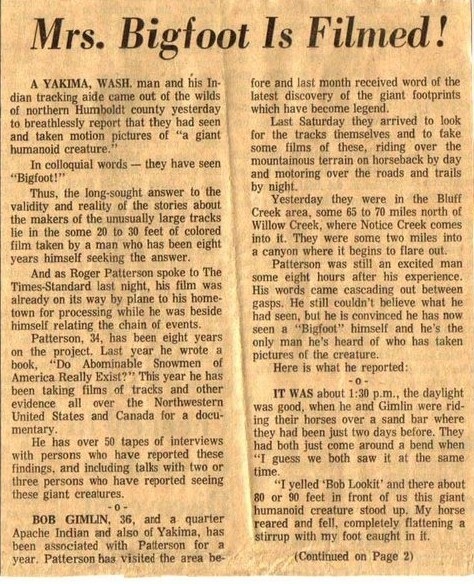
Times-Standard Initial Report, October 21, 1967, Page 1

Times-Standard Initial Report, October 21, 1967, Page 1

Analyst rating: Near-contemporaneous documentation of Patterson’s account, published the morning after the claimed encounter.

“Thus, the long-sought answer to the validity and reality of the stories about the makers of the unusually large tracks lie in the some 20 to 30 feet of colored film taken by a man who has been eight years himself seeking the answer.”
Record locationNewspaper clipping, page 1
Evidence classContemporary press record
Relationship to claimDocuments the earliest detailed published version of the witnesses’ account.
Authenticity assessmentThe scan is visually consistent with the attributed article. Newspaper archive provenance before the later private scan is incomplete.
What this supportsIt documents that Patterson reported the encounter, film, approximate location, timing, and physical description within hours.
What it does not supportIt repeats Patterson’s account and does not independently verify the subject or film processing.
ProvenanceScan presented by Bigfoot Encounters as page 1 of the Eureka Times-Standard article Mrs. Bigfoot Is Filmed, dated October 21, 1967.
Chain of custodyEureka Times-Standard print issue -> later clipping in a private research collection -> Bigfoot Encounters scan -> hash-verified Casebook copy.
Contemporary newspaper scan Local copy hash-verified

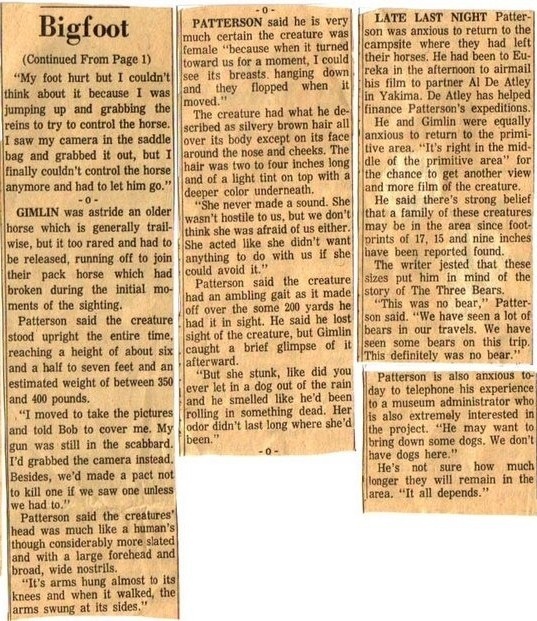
Times-Standard Initial Report, October 21, 1967, Page 2

Times-Standard Initial Report, October 21, 1967, Page 2

Analyst rating: Continuation of the first published account, including Patterson’s description and post-encounter actions.

“This was no bear, Patterson said. We have seen a lot of bears in our travels. We have seen some bears on this trip. This definitely was no bear.”
Record locationNewspaper clipping, continued from page 1
Evidence classContemporary press record
Relationship to claimContinues the earliest detailed published account.
Authenticity assessmentThe scan is visually consistent with a continuation clipping. Its full print-page context and library microfilm comparison remain unverified.
What this supportsIt preserves early claims about size, appearance, movement, track lengths, mailing the film, and plans to return.
What it does not supportIt does not independently corroborate those claims or establish the precise film-processing timeline.
ProvenanceScan presented by Bigfoot Encounters as the continuation of the Eureka Times-Standard article Mrs. Bigfoot Is Filmed, dated October 21, 1967.
Chain of custodyEureka Times-Standard print issue -> later clipping in a private research collection -> Bigfoot Encounters scan -> hash-verified Casebook copy.
Contemporary newspaper scan Local copy hash-verified

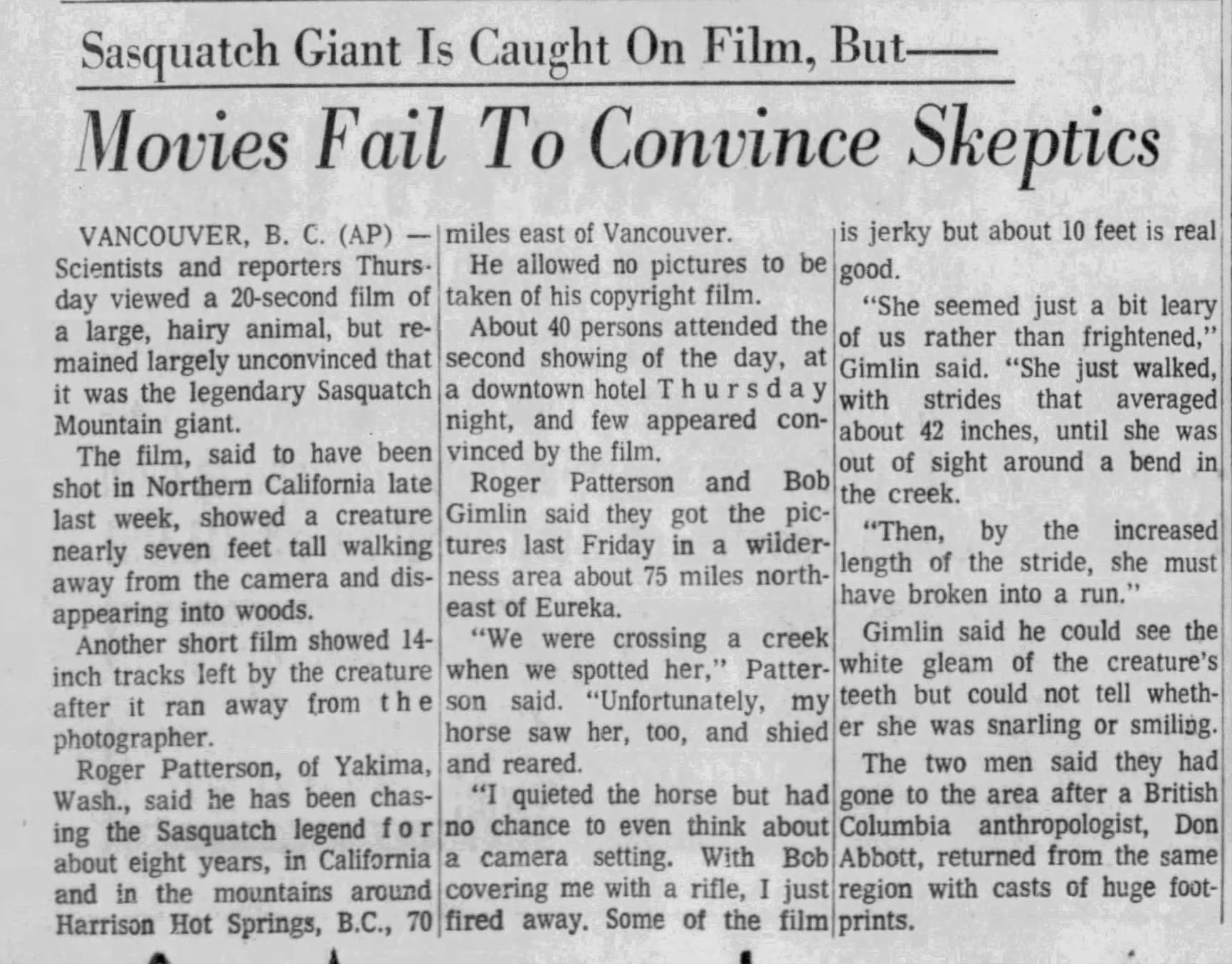
Sacramento Bee Associated Press Screening Report, October 27, 1967

Sacramento Bee Associated Press Screening Report, October 27, 1967

Analyst rating: Important early skeptical reaction from a public screening one week after the claimed filming.

“Scientists and reporters Thursday viewed a 20-second film of a large, hairy animal, but remained largely unconvinced that it was the legendary Sasquatch Mountain giant.”
Record locationSingle newspaper clipping
Evidence classContemporary press record and skeptical reaction
Relationship to claimProvides early external reporting about how the film was presented and received.
Authenticity assessmentThe scan is legible and matches Internet Archive metadata, but no independent library catalog check has yet confirmed the clipping’s issue and page.
What this supportsIt documents an early screening, skeptical attendees, Patterson and Gimlin’s public description, and claims that additional footage showed tracks.
What it does not supportIt does not authenticate the filmed subject, establish the shown copy’s generation, or preserve testimony from every attendee.
ProvenanceInternet Archive image item attributed to The Sacramento Bee, dated October 27, 1967, carrying an Associated Press report from Vancouver.
Chain of custodySacramento Bee print clipping -> unknown private custody -> Internet Archive upload -> hash-verified Casebook copy.
Published analytical paper Local copy hash-verified

Analysis Integrity of the Patterson-Gimlin Film Image

Analyst rating: Detailed source and image-integrity study arguing that examined copies retain analyzable information. The authors’ conclusions remain contested and do not identify the subject.

“A comprehensive study of these issues of contention has determined that the film was not altered or otherwise tampered with for deceptive intent, and that the image quality is sufficient for factual analysis of the nature of the subject as depicted.”
Record locationPDF pages 1 to 39
Evidence classPublished image-integrity analysis
Relationship to claimEvaluates whether surviving film images are suitable for further analysis.
Authenticity assessmentHigh confidence in document authenticity from institutional hosting. The paper represents its authors’ analysis, not scientific consensus.
What this supportsIt documents copy-history questions, image-quality tests, camera and film discussion, and the authors’ conclusion that the examined image was not deceptively altered.
What it does not supportIt does not prove the subject is an unknown animal, substitute for the missing original, or eliminate staging before filming.
ProvenancePDF published by Idaho State University’s Relict Hominoid Inquiry, volume 2, 2013, by Bill Munns and Jeff Meldrum.
Chain of custodyAuthor manuscript or journal PDF -> Idaho State University institutional hosting -> hash-verified Casebook copy.
Published analytical paper Local copy hash-verified

The Patterson-Gimlin Film: Some Noteworthy Insights

Analyst rating: A measurement-focused discussion of selected frames, gait, stature, and film-speed assumptions.

“The motion picture film of an alleged bigfoot taken by Roger Patterson and Bob Gimlin in October 1967 is examined and data are provided on the movement and stature of the bigfoot.”
Record locationPDF pages 1 to 16
Evidence classPublished measurement analysis
Relationship to claimProvides a concrete example of the pro-authenticity measurement literature and its assumptions.
Authenticity assessmentHigh confidence in document authenticity from institutional hosting. Conclusions depend on disputed inputs and should not be treated as consensus.
What this supportsIt identifies frame ranges and lays out calculations and assumptions used to estimate movement and stature.
What it does not supportIt does not resolve the disputed frame rate, camera geometry, scale references, or subject identity.
ProvenancePDF published by Idaho State University’s Relict Hominoid Inquiry, volume 6, 2017, by Christopher Murphy.
Chain of custodyAuthor brief communication -> Idaho State University institutional hosting -> hash-verified Casebook copy.
Research bibliography Local copy hash-verified

Patterson-Gimlin Film Bibliography, 2022

Analyst rating: A broad map of books, articles, interviews, broadcasts, and analyses for deeper case research.

“Partially annotated bibliography specific to the Patterson-Gimlin film, October 20, 1967, as compiled by Daniel Perez.”
Record locationPDF pages 1 to 32
Evidence classResearch bibliography
Relationship to claimSupports source discovery and historical depth rather than the biological claim itself.
Authenticity assessmentHigh confidence in document authenticity from the compiler’s site. Individual cited works require separate verification.
What this supportsIt documents the extraordinary volume and range of commentary and points to early and later sources.
What it does not supportIt is not primary evidence, does not verify every citation, and reflects the compiler’s selection decisions.
ProvenancePartially annotated bibliography compiled and copyrighted by Daniel Perez, current through February 2022, published on Bigfoot Times.
Chain of custodyCompiler’s PDF -> Bigfoot Times hosting -> hash-verified Casebook research copy.

Documented Timeline

  • 1967-10-20: Patterson and Gimlin said they filmed the subject at Bluff Creek and examined a trackway afterward.
  • 1967-10-20 evening: Patterson telephoned the Eureka Times-Standard while the film was reportedly sent for processing.
  • 1967-10-21: The Times-Standard published the first known detailed newspaper account, before the developed film had been publicly evaluated.
  • 1967-10-26: Patterson and Gimlin screened a short portion for journalists and other attendees in Vancouver.
  • 1967-10-27: An Associated Press report described skeptical reactions to the Vancouver screening.
  • 1993-1994: David Glickman reported examining and digitizing a first-generation copy for the NASI analysis.
  • 2013: Bill Munns and Jeff Meldrum published an analysis of film-image integrity and copy history.
  • 2017: Christopher Murphy published a brief communication about frame sequences, speed, and stature.
  • 2022: Daniel Perez published a partially annotated bibliography dedicated to the film.

Named Participants and Roles

  • Roger Patterson: filmmaker and principal claimant.
  • Bob Gimlin: accompanying witness who said he observed the subject and covered Patterson with a rifle.
  • Betty Allen and the Eureka Times-Standard: reportedly received Patterson’s account on the evening of October 20 and published it the next morning.
  • Journalists and attendees at the October 26 Vancouver screenings: early viewers whose reactions were reported by the Associated Press.
  • John Green, René Dahinden, and other later investigators: examined copies, the location, or claimed track evidence, with varying custody documentation.

Contradictions and Record Conflicts

  • The exact camera frame rate is disputed, materially changing gait and speed calculations.
  • The original camera film is not available for independent inspection, so analyses rely on copies of differing generations and quality.
  • Early reports vary on estimated subject height, track dimensions, duration, distance, and the sequence of post-encounter events.
  • Later claims about a suit and performer conflict with authenticity arguments but are not resolved by a documented physical costume or complete production record.
  • The first newspaper account records Patterson’s story promptly but is not independent corroboration of the subject’s identity.

Conventional Explanations

  • A human performer wearing a custom fur suit.
  • A staged sequence created for Patterson’s planned Bigfoot documentary.
  • Ordinary human gait and proportions altered by camera motion, uncertain frame rate, perspective, and copy degradation.

Missing Evidence

  • The original exposed 16mm camera film with a complete custody and laboratory-processing record.
  • The camera itself with verified settings used for the subject sequence.
  • Original field notes, measured survey points, and a complete trackway map made at the scene.
  • Track casts and soil-control impressions with uninterrupted custody documentation.
  • Uncompressed first-generation scans made directly from the best surviving film element.
  • A physical suit or production record that can be conclusively linked to the filmed subject.

What Remains Unresolved

  • The public reference film unmistakably depicts a walking, hair-covered bipedal figure, but the image alone does not identify it.
  • Contemporary reports establish that Patterson and Gimlin made the claim within hours, not that the claimed creature was biological.
  • Published measurements depend on disputed scale, frame rate, camera position, and film-generation assumptions.
  • No included source conclusively proves either an unknown animal or a staged costume performance.

Investigative Hypotheses

  • The film records an unknown biological animal.
  • The film records a human performer in a fabricated suit.
  • The visible proportions and gait are distorted by distance, lens characteristics, camera motion, copy generation, playback speed, or later stabilization.

Open Questions

  • Where is the original camera film, and can it be independently examined with a documented chain of custody?
  • What camera speed was used during the subject sequence?
  • Can the claimed trackway dimensions and camera position be reconstructed from securely documented field measurements?
  • What generation and processing history produced each surviving reference copy?

Archival Landing Pages and Evidence Corpus

Wikimedia Commons Complete Reel Reference Copy

Primary Film Reference Copy Local Source Verified

External URL: https://commons.wikimedia.org/wiki/File:Patterson_Gimlin_film.webm

Open Local Artifact (MP4 Document) · Download Copy

Eureka Times-Standard Initial Report, October 21, 1967

Contemporary Newspaper Scan

External URL: http://www.bigfootencounters.com/articles/9-inch-track.htm

Sacramento Bee Associated Press Report, October 27, 1967

Contemporary Newspaper Scan Local Source Verified

External URL: https://archive.org/details/sasquatch-giant-is-caught-on-film

Open Local Artifact (JPG Document) · Download Copy

Munns and Meldrum Film Image Integrity Analysis, 2013

Published Analysis Local Source Verified

External URL: https://www.isu.edu/media/libraries/rhi/research-papers/ANALYSIS-INTEGRITY-OF-THE-PATTERSON-GIMLIN-FILM-IMAGE_final.pdf

Open Local Artifact (PDF Document) · Download Copy

Murphy Patterson-Gimlin Film Insights, 2017

Published Analysis Local Source Verified

External URL: https://www.isu.edu/media/libraries/rhi/brief-communications/Murphy_PGFilmInsights.pdf

Open Local Artifact (PDF Document) · Download Copy

Perez Patterson-Gimlin Film Bibliography, 2022

Research Bibliography Local Source Verified

External URL: https://www.bigfoottimes.net/wp-content/uploads/2022/05/pg-bibliography.pdf

Open Local Artifact (PDF Document) · Download Copy

Media Context

Editorial context only: These IMDb listings document adaptations, documentaries, or cultural references. They do not constitute evidence, corroboration, or investigative testimony.

Finding Bigfoot (2011)

television series investigative entertainment inspired by the case

A reality series that repeatedly revisits Bigfoot reports and the cultural legacy of the 1967 footage.

IMDb ID: tt1948830 · Verified 2026-08-05