FILE DEPT

Field Report Archive

Private Skeptical Evidence Corpus

← Back to Case Files

Disappearance Incident
Evidence Dossier

Legacy category: disappearances

The Abandonment of the Mary Celeste

Evidence Dossier: A record proves that a statement, transfer, examination, or result was documented. It does not automatically prove the anomalous interpretation attached to it.
1872-11-07, 1872-12-04, 1872-12-16, 1873-03-24
Atlantic Ocean west of Gibraltar, Gibraltar, New York City, New York, Genoa, Italy
8/10
4/10
Mary Celeste was recovered derelict and brought to Gibraltar in December 1872, while the captain, his family, officers, and crew remained missing and the cause of desertion was unresolved.
moderate

Investigative Assessments

"The reported claim remains worth testing against the record: Mary Celeste was recovered derelict and brought to Gibraltar in December 1872, while the captain, his family, officers, and crew remained missing and the cause of desertion was unresolved. The strongest documented reasons to keep the file open are: Morning Star, December 20, 1872, page 3: first American shipping notice of the derelict Mary Celeste: Supports the core fact that Mary Celeste left New York for Genoa with petroleum cargo and was later brought derelict into Gibraltar; New York Herald, March 14, 1873, page 1: J. H. Winchester & Co. statement on Mary Celeste: Supports the vessel's documented commercial history and the owners' contemporary acknowledgment that the captain, family, officers, and crew were missing. Key unresolved lead: What caused the people aboard to leave the vessel?"
"Evidentiary limitations: moderate Note that: Morning Star, December 20, 1872, page 3: first American shipping notice of the derelict Mary Celeste fails to support: Does not identify who abandoned the vessel, why they left, or what happened to them; New York Herald, March 14, 1873, page 1: J. H. Winchester & Co. statement on Mary Celeste fails to support: The interested owners' denial does not independently prove the validity of every registration or insurance claim. Documented contradiction: The Treasury circular repeated grave suspicions of murder and drunkenness, but framed them as suspicion while requesting evidence to discover the facts. Leading conventional hypothesis: Emergency evacuation followed by loss of the boat and occupants at sea."

Case Summary

Mary Celeste left New York for Genoa in November 1872 and was found derelict in the eastern Atlantic in December. A December 20 shipping notice reported that the vessel had been brought into Gibraltar. A signed March 1873 statement from her owners described the vessel's registration, rebuilding, insurance, and the unexplained absence of Captain Benjamin Briggs, his family, officers, and crew. A Treasury Department circular then requested information that could establish the facts of the desertion. The staged records establish abandonment and an unresolved federal inquiry, but they do not prove the cause or the missing people's fate.

Evidence Locker

3 inspectable evidence items. Claims and source findings are kept separate.

complete-newspaper-page Local copy hash-verified

Morning Star, December 20, 1872, page 3: first American shipping notice of the derelict Mary Celeste
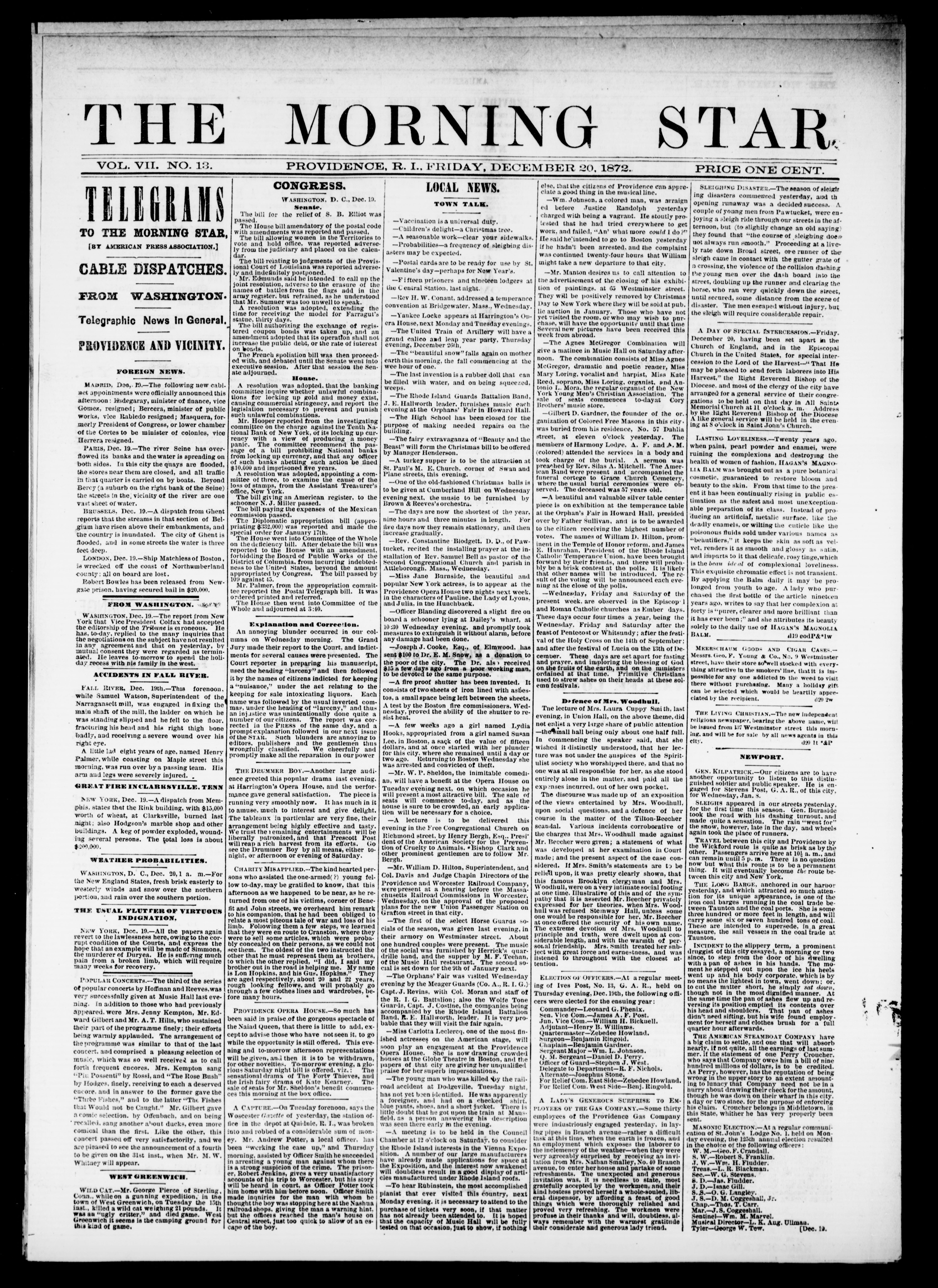
Morning Star, December 20, 1872, page 3: first American shipping notice of the derelict Mary Celeste

Analyst rating: A near-contemporaneous maritime shipping notice reporting the vessel's departure, cargo, destination, derelict status, and arrival at Gibraltar.

“Brig Mary Celeste, of and from New York Nov 7, with petroleum, for Genoa, has been picked up derelict and towed into Gibraltar Dec 16.”
Record locationnewspaper page 3, Disasters column
Evidence classnear-primary contemporaneous press record
Relationship to claimEarliest staged public report of the abandonment and recovery.
Authenticity assessmentComplete high-resolution scan of the original newspaper page served from the Library of Congress National Digital Newspaper Program.
What this supportsSupports the core fact that Mary Celeste left New York for Genoa with petroleum cargo and was later brought derelict into Gibraltar.
What it does not supportDoes not identify who abandoned the vessel, why they left, or what happened to them.
ProvenanceMorning Star (Providence, Rhode Island), December 20, 1872, page 3; digitized in the Library of Congress Chronicling America collection.
Chain of custodyOriginal newspaper issue; National Digital Newspaper Program scan; Library of Congress IIIF image service; application-owned JPEG downloaded directly from the LOC image endpoint.
Source completenessComplete. The local artifact is the full newspaper page, including masthead/page identity and the complete incident item; it is not a clipping or model-authored transcription.
Known gaps: The rest of the multi-page newspaper issue is not staged because the evidence unit is the complete cited page.
complete-newspaper-page-with-owner-statement Local copy hash-verified

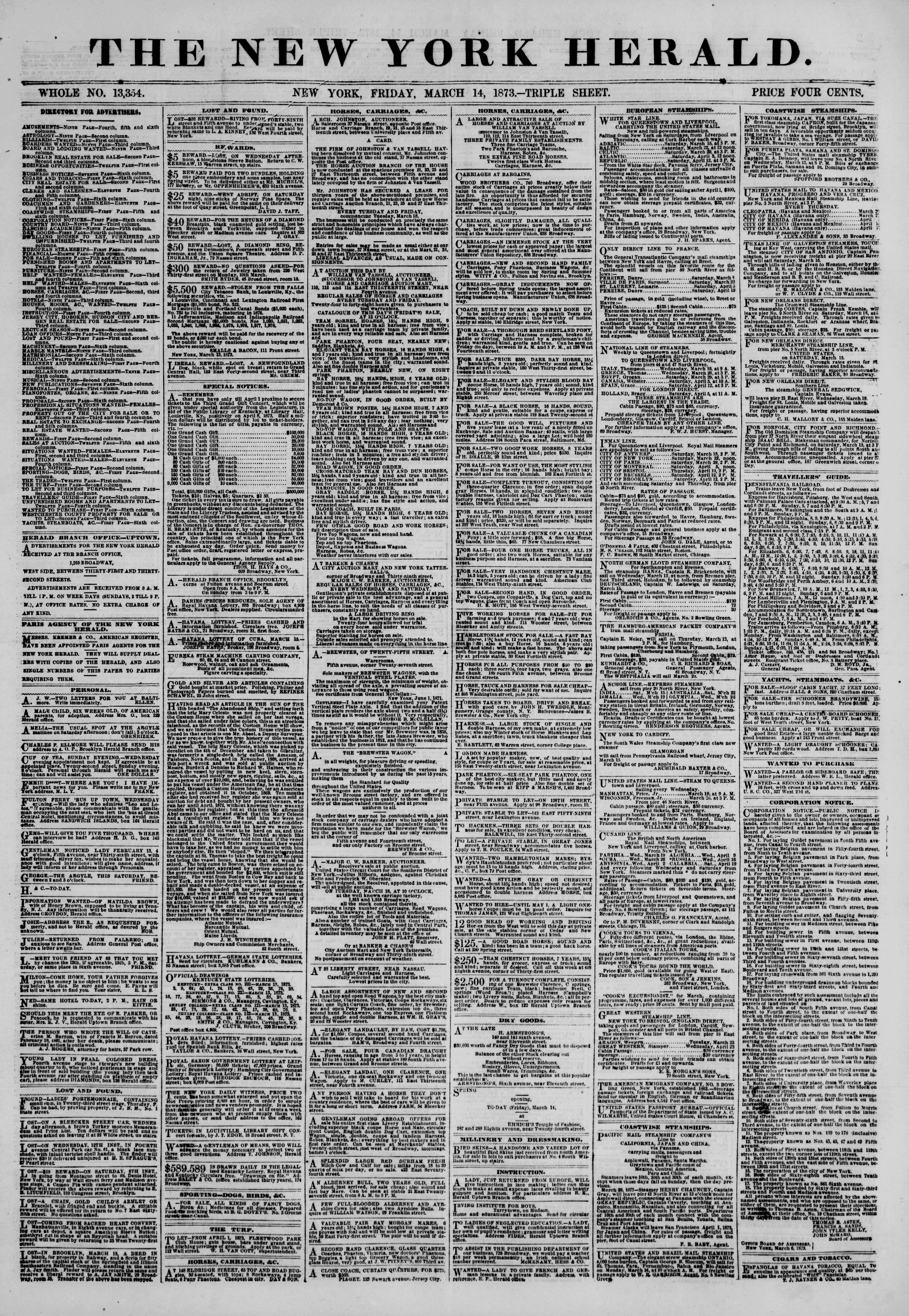
New York Herald, March 14, 1873, page 1: J. H. Winchester & Co. statement on Mary Celeste

New York Herald, March 14, 1873, page 1: J. H. Winchester & Co. statement on Mary Celeste

Analyst rating: A signed statement by the ship's owners correcting claims about clearance and registration while describing the vessel's ownership, rebuilding, valuation, and unresolved missing people.

“What has become of the captain, his wife and child, officers and crew?”
Record locationnewspaper page 1, J. H. Winchester & Co. statement
Evidence classnear-primary interested-party statement
Relationship to claimContemporary named-source response that corrects sensational claims but requires interest-aware weighting.
Authenticity assessmentComplete high-resolution scan of the original newspaper page served from the Library of Congress National Digital Newspaper Program.
What this supportsSupports the vessel's documented commercial history and the owners' contemporary acknowledgment that the captain, family, officers, and crew were missing.
What it does not supportThe interested owners' denial does not independently prove the validity of every registration or insurance claim.
ProvenanceNew York Herald, March 14, 1873, page 1; signed statement of J. H. Winchester & Co.; digitized in Library of Congress Chronicling America.
Chain of custodyOriginal newspaper issue; National Digital Newspaper Program scan; Library of Congress IIIF image service; application-owned JPEG downloaded directly from the LOC image endpoint.
Source completenessComplete. The local artifact is the full newspaper page, including masthead/page identity and the complete incident item; it is not a clipping or model-authored transcription.
Known gaps: The rest of the multi-page newspaper issue is not staged because the evidence unit is the complete cited page.
complete-newspaper-page-reproducing-official-circular Local copy hash-verified

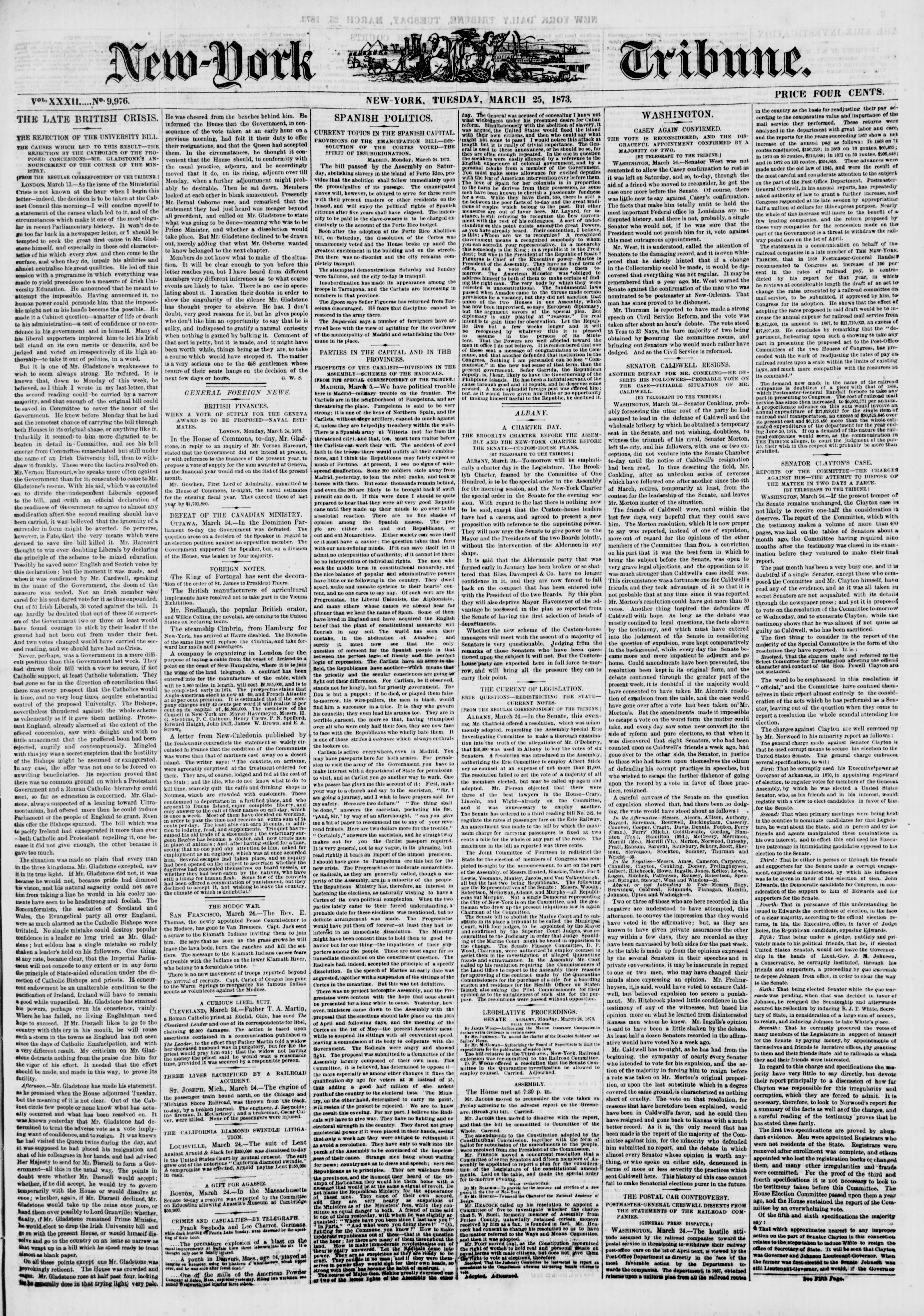
New-York Tribune, March 25, 1873, page 5: Treasury Department circular on Mary Celeste

New-York Tribune, March 25, 1873, page 5: Treasury Department circular on Mary Celeste

Analyst rating: A complete newspaper page reproducing Secretary of the Treasury William A. Richardson's circular requesting evidence about the desertion.

“You are requested to furnish this Department with any information you may be able to obtain affording a clue which may lead to a discovery of all the facts concerning the desertion of a vessel”
Record locationnewspaper page 5, Supposed Tragedy at Sea
Evidence classofficial corrective record reproduced contemporaneously
Relationship to claimIndependent federal inquiry record separating confirmed vessel facts from unproven suspicions.
Authenticity assessmentComplete high-resolution scan of the original newspaper page served from the Library of Congress National Digital Newspaper Program; the circular is signed in print by Treasury Secretary William A. Richardson.
What this supportsSupports that the federal government treated the cause and fate of those aboard as unresolved and sought information from customs officials.
What it does not supportThe circular's murder and drunkenness language is expressly suspicion, not a confirmed finding.
ProvenanceNew-York Tribune, March 25, 1873, page 5, reproducing a Treasury Department circular issued by William A. Richardson; digitized in Library of Congress Chronicling America.
Chain of custodyOriginal newspaper issue; National Digital Newspaper Program scan; Library of Congress IIIF image service; application-owned JPEG downloaded directly from the LOC image endpoint.
Source completenessComplete. The local artifact is the full newspaper page, including masthead/page identity and the complete incident item; it is not a clipping or model-authored transcription.
Known gaps: The rest of the multi-page newspaper issue is not staged because the evidence unit is the complete cited page.

Documented Timeline

  • 1872-11-07: The staged shipping notice identifies Mary Celeste as having departed New York for Genoa with petroleum.
  • 1872-12-04: Later contemporary records state that Mary Celeste was picked up derelict in the Atlantic.
  • 1872-12-16: The Providence shipping notice reports the vessel towed into Gibraltar.
  • 1873-03-14: J. H. Winchester & Co. publishes a signed account of the vessel's registration, rebuilding, insurance, and missing people.
  • 1873-03-24: The Treasury Department issues a circular seeking information about the desertion; the Tribune prints it the next day.

Named Participants and Roles

  • J. H. Winchester & Co., Mary Celeste owners and commission merchants. Account basis: Contemporaneous. Witness quality: Moderate. Named contemporary owners with direct commercial knowledge, but financially interested and therefore not independent. Evidence: mc-owner-rebuttal-1873
  • William A. Richardson, United States Secretary of the Treasury. Account basis: Documentary-Only. Witness quality: High. Named federal official whose signed circular defines what the government knew and what remained under investigation. Evidence: mc-treasury-circular-1873

Contradictions and Record Conflicts

  • The Treasury circular repeated grave suspicions of murder and drunkenness, but framed them as suspicion while requesting evidence to discover the facts.
  • The owners rejected allegations about improper clearance and a false flag, but their signed statement was an interested-party rebuttal rather than an adjudicated finding.

Conventional Explanations

  • Emergency evacuation followed by loss of the boat and occupants at sea.
    Evidence for: The vessel was recovered without the captain, family, officers, or crew, and the government sought evidence about the desertion.
    Limits: The staged records do not establish the specific emergency or the missing people's subsequent route.
    Evidence: mc-initial-derelict-notice, mc-owner-rebuttal-1873, mc-treasury-circular-1873
  • Foul play or mutiny.
    Evidence for: The Treasury circular recorded contemporary suspicions.
    Limits: The circular did not present those suspicions as established facts, and the staged sources contain no adjudicated proof of murder or mutiny.
    Evidence: mc-treasury-circular-1873

Evidence Stance Matrix

HypothesisStanceRationaleEvidence IDs
The people aboard left in an emergency and were lost at sea.MixedAbandonment is established, but the emergency and later loss are not directly observed in these records.mc-initial-derelict-notice, mc-treasury-circular-1873
Foul play caused the abandonment.MixedThe Treasury circular records suspicion but simultaneously seeks facts; no staged record confirms foul play.mc-treasury-circular-1873
A perceived cargo, weather, or seaworthiness danger prompted a mistaken evacuation.MixedThe staged sources identify cargo and abandonment but do not document the decision to evacuate.mc-initial-derelict-notice, mc-owner-rebuttal-1873

Missing Evidence

  • Complete original Gibraltar Vice-Admiralty proceeding and the missing people's final records.
    Would permit direct testing of vessel-condition testimony and any explanation for the decision to abandon ship.

What Remains Unresolved

  • The cause of the abandonment and fate of every missing person.
    The staged contemporaneous records establish recovery and inquiry but report no conclusive explanation or recovery of the missing people.

Investigative Hypotheses

  • The people aboard left in an emergency and were lost at sea.
  • Foul play caused the abandonment.
  • A perceived cargo, weather, or seaworthiness danger prompted a mistaken evacuation.

Open Questions

  • What caused the people aboard to leave the vessel?
  • What happened to Captain Briggs, his family, and the crew after the abandonment?

Archival Landing Pages and Evidence Corpus

Morning Star, December 20, 1872, page 3: first American shipping notice of the derelict Mary Celeste

Complete-Newspaper-Page Local Source Verified

External URL: https://www.loc.gov/resource/sn83021432/1872-12-20/ed-1/?sp=3

Open Local Artifact (JPG Document) · Download Copy

New York Herald, March 14, 1873, page 1: J. H. Winchester & Co. statement on Mary Celeste

Complete-Newspaper-Page-With-Owner-Statement Local Source Verified

External URL: https://www.loc.gov/resource/sn83030313/1873-03-14/ed-1/?sp=1

Open Local Artifact (JPG Document) · Download Copy

New-York Tribune, March 25, 1873, page 5: Treasury Department circular on Mary Celeste

Complete-Newspaper-Page-Reproducing-Official-Circular Local Source Verified

External URL: https://www.loc.gov/resource/sn83030214/1873-03-25/ed-1/?sp=5

Open Local Artifact (JPG Document) · Download Copy