The Moon Hoax, 1859 reprint
Analyst rating: Central surviving compilation of the serial text
“Among this class of extraordinary fictitious narratives may be placed the renowned Moon Hoax.”
Known gaps: No known completeness gaps recorded.
Private Skeptical Evidence Corpus
Legacy category: Hoax / Forgery
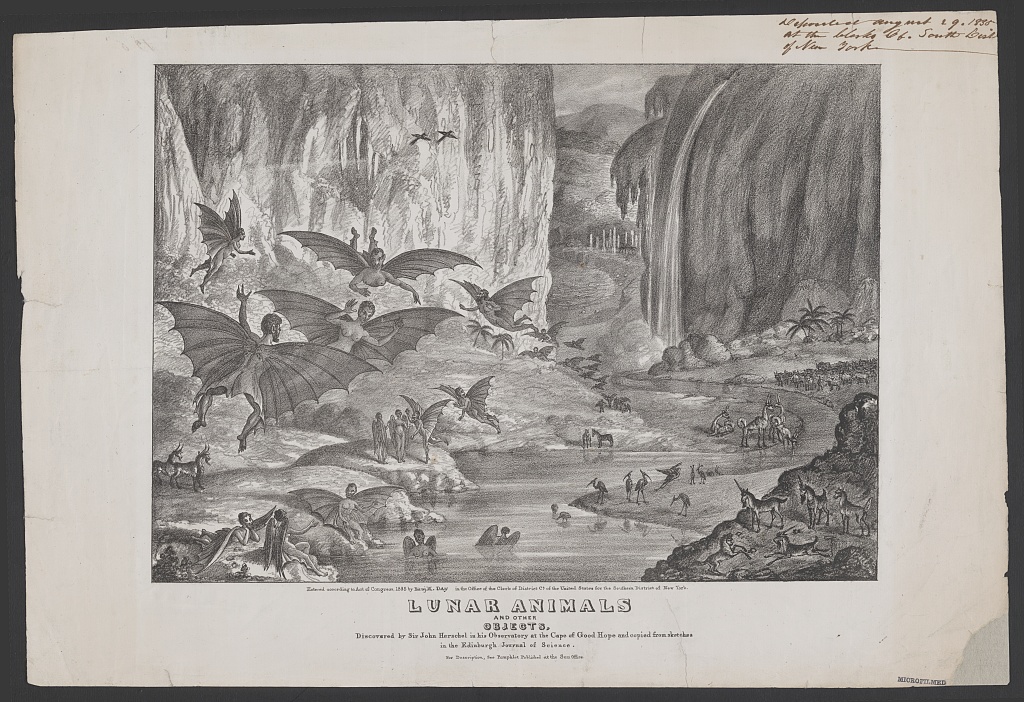
"The reported claim remains worth testing against the record: The Great Moon Hoax fabricated a scientific correspondent, telescope capabilities, and lunar life claims around John Herschel's real Cape observing program. The strongest documented reasons to keep the file open are: The Moon Hoax, 1859 reprint: It preserves the invented telescope, fictitious Dr. Andrew Grant, and lunar life descriptions attributed to Herschel; Lunar animals and other objects: It shows the human-bat creatures and other lunar beings associated with the Sun story and bears an 1835 deposit history. Key unresolved lead: Can complete open scans of the August 25 through 31, 1835 Sun issues be acquired?"
"Evidentiary limitations: Strong for the hoax text, associated 1835 imagery, and the mismatch with Herschel's real publication; limited by the absence of open scans of the original August 1835 Sun issues. Note that: The Moon Hoax, 1859 reprint fails to support: It is a later compilation, not a facsimile of the original daily newspaper pages; Lunar animals and other objects fails to support: The staged JPEG is a 1024-pixel service derivative and does not prove how readers interpreted the serial. Documented contradiction: The serial invokes a Dr. Andrew Grant, while the real Cape publication is authored by Herschel and contains no lunar animal discoveries. Leading conventional hypothesis: A commercially successful newspaper fiction borrowed the authority of a real scientific expedition."
The New York Sun published a serial claiming that John Herschel's Cape telescope revealed lunar landscapes and winged humanoids. The original daily issues are not available in the open institutional sources inspected, so this dossier uses a complete 1859 reprint, the Library of Congress copyright-deposit lithograph tied to the series, and Herschel's real Cape observations as a control record.
3 inspectable evidence items. Claims and source findings are kept separate.
Analyst rating: Central surviving compilation of the serial text
“Among this class of extraordinary fictitious narratives may be placed the renowned Moon Hoax.”
Analyst rating: Institutional image directly cataloged to the Great Moon Hoax
“Lunar animals and other objects Discovered by Sir John Herschel.”
Analyst rating: Control record for Herschel's real observing program
“Astronomical Observations made during the years 1834, 5, 6, 7, 8, at the Cape of Good Hope.”
| Hypothesis | Stance | Rationale | Evidence IDs |
|---|---|---|---|
| The lunar discoveries were a deliberate newspaper fiction. | Supports | The reprint preserves the invented report and the institutional image visualizes the same fictional lunar life. | moon_reprint, moon_lithograph, moon_herschel_observations |
| The serial accurately reported Herschel's observations. | Challenges | Herschel's extensive actual results do not report the beings or telescope described by the serial. | moon_reprint, moon_herschel_observations |
| The 1859 pamphlet materially differs from the 1835 serial. | Inconclusive | Without the original issue scans, exact variants cannot be fully tested. | moon_reprint |
External URL: https://archive.org/details/moonhoax00Lock
External URL: https://www.loc.gov/item/2003665049/
External URL: https://archive.org/details/resultsofastron00hers
A documentary short centered on the 1835 newspaper hoax.
IMDb ID: tt24059682 · Verified 2026-08-06