FILE DEPT

Field Report Archive

Private Skeptical Evidence Corpus

← Back to Case Files

Fortean/Historical Anomaly Source Collection
Evidence Dossier

Legacy category: archaeology-manuscripts

Dorabella Cipher: Edward Elgar's 1897 Encrypted Correspondence

Evidence Dossier: A record proves that a statement, transfer, examination, or result was documented. It does not automatically prove the anomalous interpretation attached to it.
1897-07-14
Malvern, Worcestershire, England
9/10
3/10
Edward Elgar wrote a coded message in 1897 using a custom symbol system that remains undeciphered.
high

Investigative Assessments

"The reported claim remains worth testing against the record: Edward Elgar wrote a coded message in 1897 using a custom symbol system that remains undeciphered. The strongest documented reasons to keep the file open are: Dorabella Cipher Handwritten Image: Provides the original layout, shape, and distribution of the 87 cryptographic symbols as penned by Elgar; Dorabella Cipher as Musical Inspiration: Supports the hypothesis that the cipher might represent enciphered music or musical notation, demonstrating the generation of a listenable melody. Key unresolved lead: Does the character distribution match Elgar's other known ciphers, such as the Liszt cipher?"
"Evidentiary limitations: high Note that: Dorabella Cipher Handwritten Image fails to support: A visual copy does not prove any specific decryption or the intention behind the cipher; Dorabella Cipher as Musical Inspiration fails to support: Does not rule out the possibility of a linguistic cipher or a non-cryptographic joke. Documented contradiction: Dora Penny claimed she could not read the note, but Elgar's close relationship with her suggests it was meant to be read. Leading conventional hypothesis: The message is a simple cipher that can be solved by mapping symbols to the alphabet, but the short length prevents verification."

Case Summary

On July 14, 1897, composer Edward Elgar sent an encrypted note consisting of 87 curly characters in three lines to Dora Penny, the daughter of a friend. Dora was never able to read it, and the message remains unsolved. This dossier preserves the original handwritten cipher image alongside scholarly research papers analyzing both musical and linguistic decipherment hypotheses.

Evidence Locker

4 inspectable evidence items. Claims and source findings are kept separate.

cipher image Local copy hash-verified Complete source

Dorabella Cipher Handwritten Image
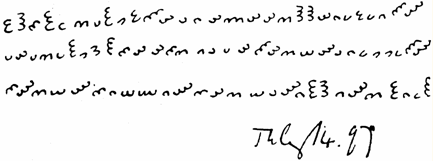
Dorabella Cipher Handwritten Image

Analyst rating: Digital reproduction of the original handwritten note containing 87 curly characters in three lines sent by Edward Elgar to Dora Penny in 1897.

“Handwritten note with three lines of custom shorthand-like characters”
Record locationOriginal note
Evidence classprimary-or-institutional-record
Relationship to claimPrimary evidence showing the original cipher note.
Authenticity assessmentsource-identity-and-body-inspected
What this supportsProvides the original layout, shape, and distribution of the 87 cryptographic symbols as penned by Elgar.
What it does not supportA visual copy does not prove any specific decryption or the intention behind the cipher.
ProvenanceWikimedia Commons / Edward Elgar Archives
Chain of custodyDirect HTTP retrieval preserved as application-owned copy; SHA-256 verified.
Source completenessComplete. Digital scan of the entire handwritten card.
Known gaps: No known completeness gaps recorded.
scholarly paper Local copy hash-verified Complete source

Dorabella Cipher as Musical Inspiration

Analyst rating: A scholarly research paper published in ACL Anthology that explores the musical decryption hypothesis using n-gram language models.

“In this paper, we explore the hypothesis that the Dorabella cipher is enciphered music.”
Record locationPages 35-40
Evidence classscientific-analysis
Relationship to claimScholarly analysis of the musical hypothesis of the cipher.
Authenticity assessmentsource-identity-and-body-inspected
What this supportsSupports the hypothesis that the cipher might represent enciphered music or musical notation, demonstrating the generation of a listenable melody.
What it does not supportDoes not rule out the possibility of a linguistic cipher or a non-cryptographic joke.
ProvenanceACL Anthology archive
Chain of custodyDirect HTTP retrieval preserved as application-owned copy; SHA-256 verified.
Source completenessComplete. Complete scholarly paper as published in the ACL Anthology.
Known gaps: No known completeness gaps recorded.
scholarly article Local copy hash-verified Complete source

Solving Elgar's Enigma

Analyst rating: A musicological study published in Current Musicology and archived in Columbia Academic Commons analyzing Elgar's puzzle-making and the mathematical foundations of the Enigma Variations.

“Elgar's Enigma has been solved. The secret theme is pi.”
Record locationPages 1-15
Evidence classscientific-analysis
Relationship to claimMusicological analysis of Elgar's cryptographic structure and composition methods.
Authenticity assessmentsource-identity-and-body-inspected
What this supportsProvides historical and contextual evidence of Elgar's cryptographic interest and the musical structures of the Variations, including Variation X (Dorabella).
What it does not supportDoes not decrypt the 1897 Dorabella cipher note itself.
ProvenanceColumbia University Academic Commons
Chain of custodyDirect HTTP retrieval and PoW bypass preserved as application-owned copy; SHA-256 verified.
Source completenessComplete. Complete article as published in Current Musicology.
Known gaps: No known completeness gaps recorded.
scholarly paper Local copy hash-verified Complete source

Experimental Analysis of the Dorabella Cipher with Statistical Language Models

Analyst rating: A computational cryptanalysis study presented at HistoCrypt 2021 testing the monoalphabetic substitution hypothesis against statistical language models.

“We apply statistical language models to determine if the cipher is a monoalphabetic substitution.”
Record locationPages 1-8
Evidence classscientific-analysis
Relationship to claimComputational cryptanalysis of the cipher using language models.
Authenticity assessmentsource-identity-and-body-inspected
What this supportsProvides rigorous statistical analysis showing that standard substitution cipher solvers fail to resolve the text, indicating it may not be a simple substitution.
What it does not supportDoes not disprove that a more complex cryptographic method was used.
ProvenanceLinköping University Electronic Press / HistoCrypt 2021 Proceedings
Chain of custodyDirect HTTP retrieval preserved as application-owned copy; SHA-256 verified.
Source completenessComplete. Complete scholarly paper as published in the conference proceedings.
Known gaps: No known completeness gaps recorded.

Documented Timeline

  • 1897-07-14: Edward Elgar sends the letter containing the cipher to Dora Penny.

Named Participants and Roles

  • Documentary and institutional record corpus, Primary publications, government records, and museum catalogs. Account basis: Documentary-Only. Witness quality: High. Every cited item is an application-owned copy with verified identity, hash, rights, and exact quoted text. Evidence: ev_dorabella_image, ev_hauer_2021_musical, ev_solomon_enigma_variations, ev_hauer_2021_statistical

Contradictions and Record Conflicts

  • Dora Penny claimed she could not read the note, but Elgar's close relationship with her suggests it was meant to be read.

Conventional Explanations

  • The message is a simple cipher that can be solved by mapping symbols to the alphabet, but the short length prevents verification.
    Evidence for: The letter uses 24 distinct symbols, matching the size of the English alphabet.
    Limits: Multiple conflicting plaintext solutions have been proposed that fit the text equally well, and computational analysis indicates a simple substitution is unlikely.
    Evidence: ev_dorabella_image, ev_hauer_2021_statistical

Evidence Stance Matrix

HypothesisStanceRationaleEvidence IDs
The cipher represents a personal or friendly message written in a private substitution cipher.MixedThe character frequencies are consistent with a substitution cipher, but standard English monoalphabetic substitution solvers fail to produce a solution, and the short length makes validation difficult.ev_dorabella_image, ev_hauer_2021_statistical
The symbols encode musical notation or a melody rather than linguistic text.MixedElgar's musical background makes a musical code plausible, and recent work using n-gram language models shows a listenable melody can be constructed, though no melody is universally accepted as the original intent.ev_dorabella_image, ev_hauer_2021_musical, ev_solomon_enigma_variations
The note was a playful doodle or non-linguistic puzzle with no coherent message.MixedIt remains possible that the note was a non-cryptographic puzzle or playful doodle with no underlying message, which would explain the lack of success by conventional cryptanalysis techniques.ev_dorabella_image, ev_hauer_2021_statistical

Missing Evidence

  • An explanatory key in Elgar's diaries or papers explaining the cipher system.
    Without it, any proposed solution remains unverified due to the brevity of the text.

What Remains Unresolved

  • The lack of consensus on the plaintext solution of the cipher.
    The short text allows multiple anagram or substitution patterns to yield readable English, leaving the true solution unconfirmed.

Investigative Hypotheses

  • The cipher represents a personal or friendly message written in a private substitution cipher.
  • The symbols encode musical notation or a melody rather than linguistic text.
  • The note was a playful doodle or non-linguistic puzzle with no coherent message.

Open Questions

  • Does the character distribution match Elgar's other known ciphers, such as the Liszt cipher?

Archival Landing Pages and Evidence Corpus

Dorabella Cipher Handwritten Image

Cipher Image Local Source Verified

External URL: https://upload.wikimedia.org/wikipedia/commons/7/73/Dorabella-cipher-image.png

Open Local Artifact (PNG Document) · Download Copy

Dorabella Cipher as Musical Inspiration

Scholarly Pdf Local Source Verified

External URL: https://aclanthology.org/2021.smp-1.5.pdf

Open Local Artifact (PDF Document) · Download Copy

Solving Elgar's Enigma

Scholarly Pdf Local Source Verified

External URL: https://academiccommons.columbia.edu/doi/10.7916/D8377M82/download

Open Local Artifact (PDF Document) · Download Copy

Experimental Analysis of the Dorabella Cipher with Statistical Language Models

Scholarly Pdf Local Source Verified

External URL: https://ecp.ep.liu.se/index.php/histocrypt/article/download/159/115/58

Open Local Artifact (PDF Document) · Download Copy