Cardiff Giant, Bain News Service photograph
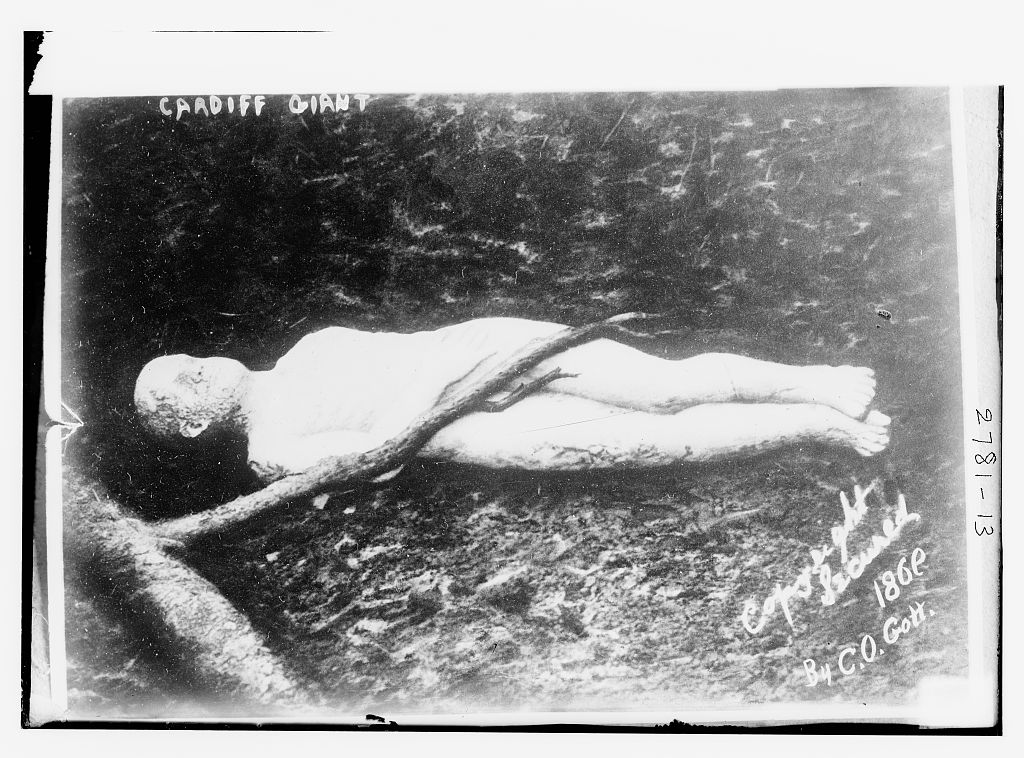
Analyst rating: Institutional visual record of the exhibited object
“Cardiff Giant.”
Known gaps: The archival TIFF master was not staged; the LOC service derivative was used.
Private Skeptical Evidence Corpus
Legacy category: Hoax / Forgery
"The reported claim remains worth testing against the record: The Cardiff Giant was a recently carved gypsum statue planted and exhibited as an ancient petrified giant. The strongest documented reasons to keep the file open are: Cardiff Giant, Bain News Service photograph: It preserves the appearance and exhibition context of the object later cataloged as the Cardiff Giant; The Cardiff Giant Controversy: It reproduces O. C. Marsh's physical assessment that the gypsum figure was recent and a decided humbug. Key unresolved lead: Can George Hull's direct confession or carving contract be acquired from a public archive?"
"Evidentiary limitations: Strong historical documentation from a contemporary scientific society report, an eyewitness memoir, and an institutional photograph; the staged lane does not include the original carving contract or court file. Note that: Cardiff Giant, Bain News Service photograph fails to support: It does not document manufacture, burial, or the 1869 discovery; The Cardiff Giant Controversy fails to support: It is a published report and not Marsh's original field notebook or the object's complete custody record. Documented contradiction: Promoters described ancient remains, while Marsh reported fresh workmanship and gypsum inconsistent with great antiquity. Leading conventional hypothesis: George Hull commissioned a gypsum carving, artificially aged it, and arranged its burial and discovery."
A carved gypsum figure was buried on William Newell's farm and unearthed during well digging in October 1869. A near-contemporary scientific report reproduced O. C. Marsh's conclusion that the object was of very recent origin and a decided humbug. A later eyewitness memoir describes the inspection and eventual exposure, while the Library of Congress image preserves the exhibited object.
3 inspectable evidence items. Claims and source findings are kept separate.
Analyst rating: Institutional visual record of the exhibited object
“Cardiff Giant.”
Analyst rating: Near-contemporary publication of scientific criticism
“It is of very recent origin, and a most decided humbug.”
Analyst rating: Retrospective firsthand account by a visitor who inspected the figure
“CHAPTER LVI. THE CARDIFF GIANT: A CHAPTER IN THE HISTORY OF HUMAN FOLLY.”
| Hypothesis | Stance | Rationale | Evidence IDs |
|---|---|---|---|
| The figure was a deliberately planted modern carving. | Supports | Recent tool work and gypsum material support deliberate modern manufacture. | cardiff_photo, cardiff_controversy, cardiff_white |
| The figure was a naturally petrified ancient human. | Challenges | The material and workmanship are those of a carved gypsum figure, not fossilized anatomy. | cardiff_controversy, cardiff_white |
| The figure was an ancient sculpture later misrepresented as petrified remains. | Challenges | Marsh specifically described it as of very recent origin. | cardiff_controversy |
External URL: https://www.loc.gov/item/2014693762/
External URL: https://archive.org/details/jstor-25079407
External URL: https://archive.org/details/autobiographyofa01370gut
An In Search of History episode centered on the Cardiff Giant hoax.
IMDb ID: tt0401507 · Verified 2026-08-06