FILE DEPT

Field Report Archive

Private Skeptical Evidence Corpus

← Back to Case Files

Disappearance Incident
Evidence Dossier

Legacy category: disappearances

Disappearance of Benjamin Bathurst

Evidence Dossier: A record proves that a statement, transfer, examination, or result was documented. It does not automatically prove the anomalous interpretation attached to it.
1809-11-25, 1810-03-27, 1862-10-25, 1889-01-01
Perleberg, Prussia, route from Berlin toward Hamburg
8/10
3/10
Benjamin Bathurst disappeared during a journey through Perleberg in November 1809; contemporary reports and later historical reviews disagree about whether suicide, local crime, or French intervention caused his disappearance.
moderate

Investigative Assessments

"The reported claim remains worth testing against the record: Benjamin Bathurst disappeared during a journey through Perleberg in November 1809; contemporary reports and later historical reviews disagree about whether suicide, local crime, or French intervention caused his disappearance. The strongest documented reasons to keep the file open are: The Enquirer, March 27, 1810, page 1: Mr. Bathurst: Supports that Bathurst failed to reach Hamburg, that his clothing and a letter were reportedly found, and that the Prussian government offered a reward while the French and British accounts conflicted; New Hampshire Statesman, October 25, 1862, page 1: A Mysterious Crime: Supports the historical continuity of the unresolved case and preserves a detailed nineteenth-century reconstruction of the inn departure and search. Key unresolved lead: Where did Bathurst go after he was last seen at Perleberg?"
"Evidentiary limitations: moderate Note that: The Enquirer, March 27, 1810, page 1: Mr. Bathurst fails to support: The article's accusation against French agents is press argument, not proof of abduction or murder; New Hampshire Statesman, October 25, 1862, page 1: A Mysterious Crime fails to support: Published fifty-three years later without a named author; its detailed narrative is secondary and cannot substitute for missing Prussian investigation files. Documented contradiction: The French report presented suicide following apparent insanity, while the British press attributed the disappearance to French seizure; neither account supplied conclusive physical proof. Leading conventional hypothesis: Local robbery and homicide near Perleberg."

Case Summary

British diplomat Benjamin Bathurst disappeared while traveling through Perleberg in November 1809. A March 1810 newspaper report reproduced a French claim that he died by suicide and a competing British allegation that French agents seized him. It also reported recovered clothing and a Prussian reward for discovery of his body. An 1862 retrospective supplied a fuller inn-yard narrative but remained anonymous and secondary. In 1889, Sabine Baring-Gould compared family, press, register, and Prussian material, rejected a sensational Magdeburg skeleton story, and explored local murder as an alternative without resolving the case.

Evidence Locker

3 inspectable evidence items. Claims and source findings are kept separate.

complete-contemporary-newspaper-page Local copy hash-verified

The Enquirer, March 27, 1810, page 1: Mr. Bathurst
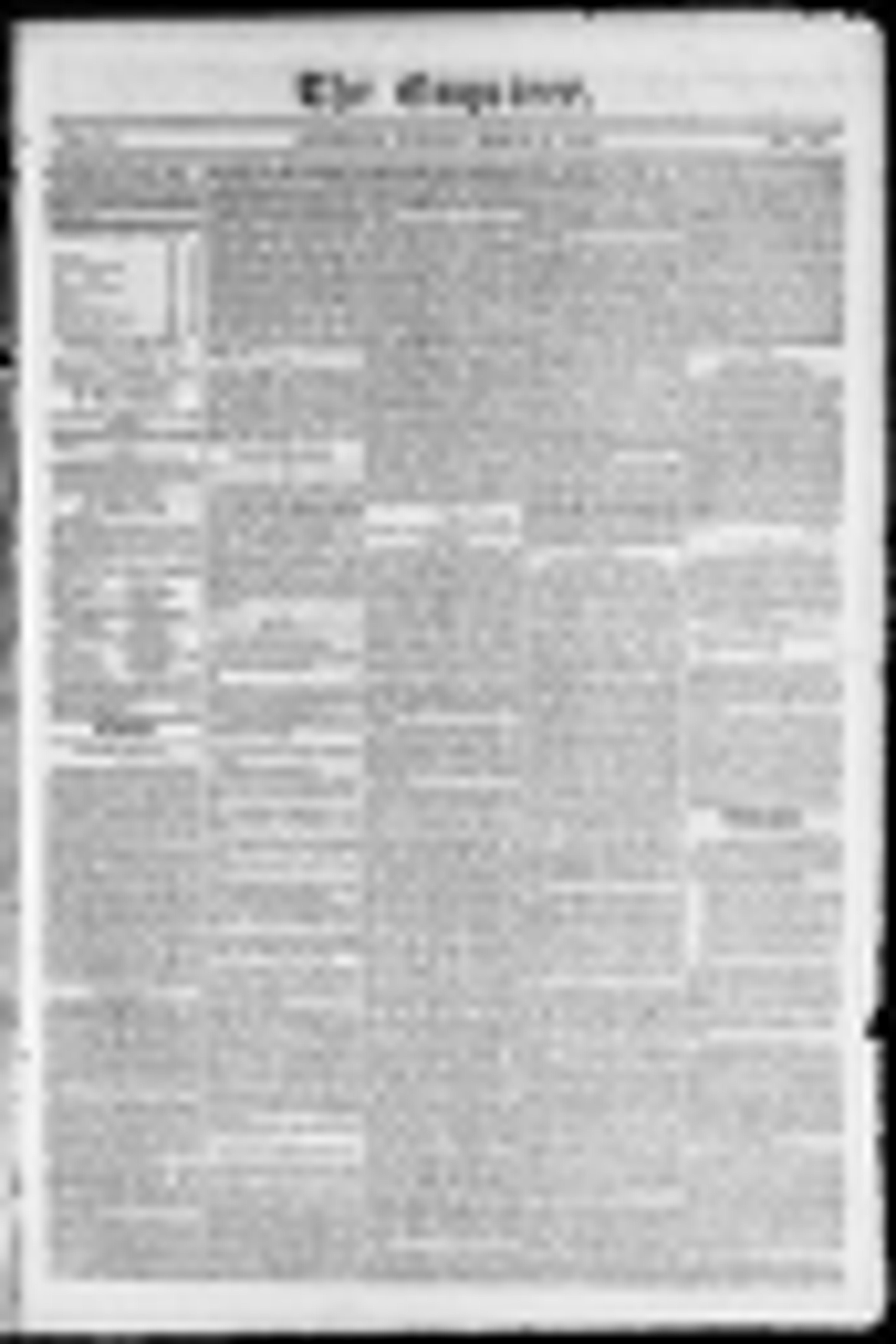
The Enquirer, March 27, 1810, page 1: Mr. Bathurst

Analyst rating: A March 1810 American newspaper page reprinting competing European reports only months after the disappearance. It records the French suicide account, the British seizure allegation, recovered clothing, and a Prussian reward.

“The Prussian government upon receiving the intelligence evinced the deepest regret, and offered a large reward for the discovery of his body.”
Record locationcomplete newspaper page 1, column headed Mr. Bathurst
Evidence classnear-primary contemporaneous press record
Relationship to claimDocuments the earliest public dispute and the limited facts then reported.
Authenticity assessmentFull high-resolution scan of the original 1810 newspaper page from the Library of Congress National Digital Newspaper Program.
What this supportsSupports that Bathurst failed to reach Hamburg, that his clothing and a letter were reportedly found, and that the Prussian government offered a reward while the French and British accounts conflicted.
What it does not supportThe article's accusation against French agents is press argument, not proof of abduction or murder.
ProvenanceThe Enquirer (Richmond, Virginia), March 27, 1810, page 1; Library of Congress Chronicling America.
Chain of custodyOriginal newspaper issue; National Digital Newspaper Program scan; LOC IIIF service; application-owned JPEG downloaded directly from the image endpoint.
Source completenessComplete. The application-owned artifact is the complete cited newspaper page or the complete ebook, not an excerpt, clipping, or model-authored transcription.
Known gaps: Other pages of the newspaper issue are not staged because the evidence unit is the complete cited page.
complete-retrospective-newspaper-page Local copy hash-verified

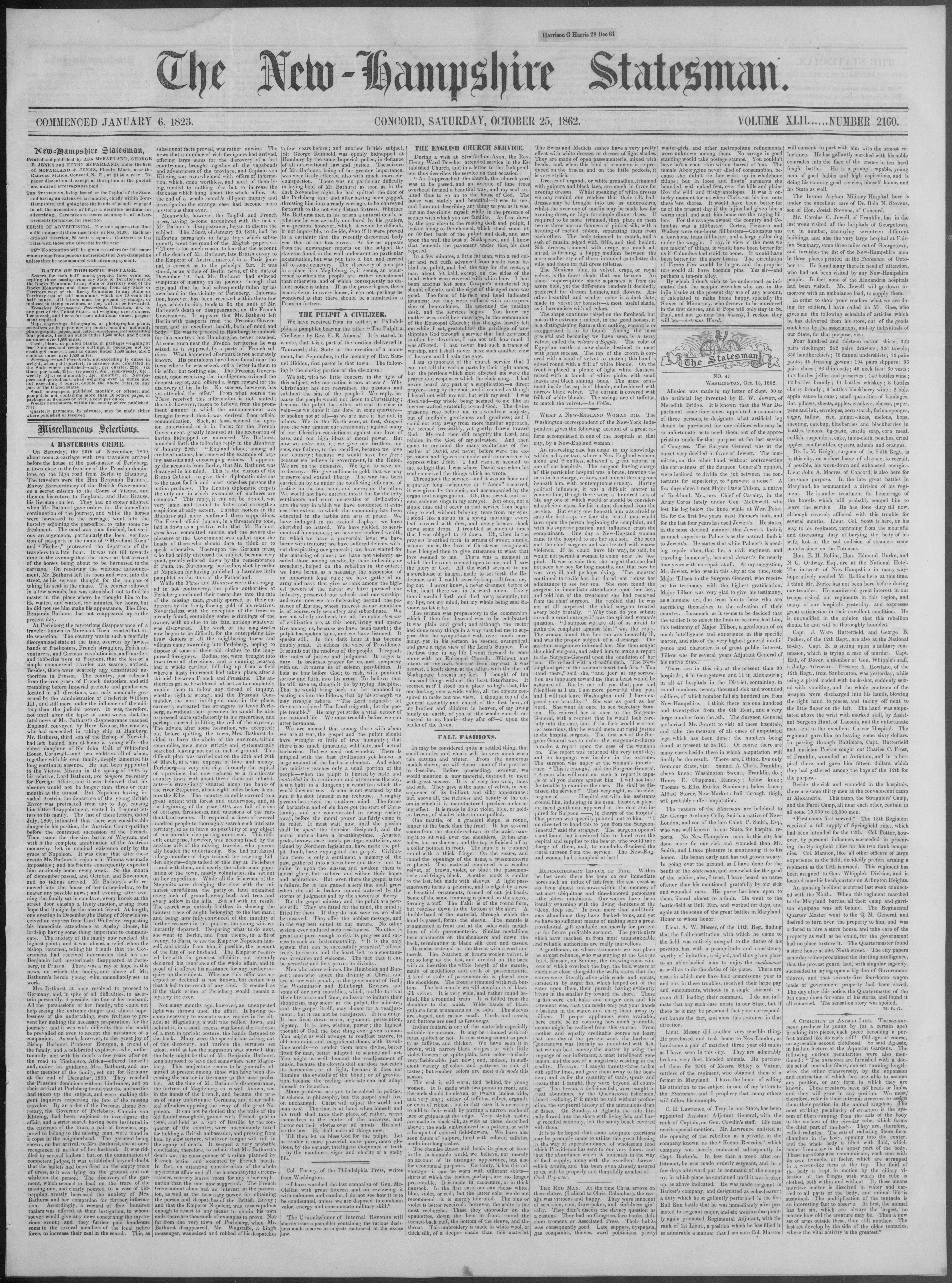
New Hampshire Statesman, October 25, 1862, page 1: A Mysterious Crime

New Hampshire Statesman, October 25, 1862, page 1: A Mysterious Crime

Analyst rating: A complete 1862 newspaper page with a long retrospective reconstruction identifying Bathurst, Krause, Perleberg, the alias travel documents, the search, and later competing claims.

“The Hon. Benjamin Bathurst has not reappeared up to the present day.”
Record locationcomplete newspaper page 1, A Mysterious Crime
Evidence classindependent nineteenth-century secondary press record
Relationship to claimProvides a fuller later account but is weighted below the 1810 report and the source-critical 1889 study.
Authenticity assessmentFull high-resolution scan of the original 1862 newspaper page from the Library of Congress National Digital Newspaper Program.
What this supportsSupports the historical continuity of the unresolved case and preserves a detailed nineteenth-century reconstruction of the inn departure and search.
What it does not supportPublished fifty-three years later without a named author; its detailed narrative is secondary and cannot substitute for missing Prussian investigation files.
ProvenanceNew Hampshire Statesman (Concord, New Hampshire), October 25, 1862, page 1; Library of Congress Chronicling America.
Chain of custodyOriginal newspaper issue; National Digital Newspaper Program scan; LOC IIIF service; application-owned JPEG downloaded directly from the image endpoint.
Source completenessComplete. The application-owned artifact is the complete cited newspaper page or the complete ebook, not an excerpt, clipping, or model-authored transcription.
Known gaps: Other pages of the newspaper issue are not staged because the evidence unit is the complete cited page.
complete-historical-source-critical-book Local copy hash-verified

Historic Oddities and Strange Events by S. Baring-Gould (1889), complete Project Gutenberg text

Analyst rating: Baring-Gould's 1889 study cites contemporary newspapers, registers, family memoirs, and Prussian investigation material, compares the rival French-agent and local-crime theories, and corrects the sensational Magdeburg skeleton claim.

“The discovery of a skeleton as described was denied afterwards by the Magdeburg papers. It was a newspaper sensational paragraph, and unfounded.”
Record locationThe Disappearance of Bathurst, footnote 1; complete ebook retained
Evidence classindependent corrective historical analysis
Relationship to claimCorrects a later false body-identification story and audits competing nineteenth-century explanations.
Authenticity assessmentComplete Project Gutenberg UTF-8 transcription of the 1889 edition, including title matter, full Bathurst chapter, footnotes, remaining book, and Gutenberg redistribution notice.
What this supportsSupports an unresolved disappearance at Perleberg and a source-critical preference for local opportunity evidence over the unsupported identification of a Magdeburg skeleton.
What it does not supportIts proposed local-murder reconstruction remains inference and does not conclusively identify a killer or body.
ProvenanceSabine Baring-Gould, Historic Oddities and Strange Events, Methuen & Co., London, 1889; Project Gutenberg ebook 44245.
Chain of custody1889 printed edition; Project Gutenberg transcription and proofing; complete UTF-8 text downloaded directly from Gutenberg; application-owned local bytes retained unchanged.
Source completenessComplete. The application-owned artifact is the complete cited newspaper page or the complete ebook, not an excerpt, clipping, or model-authored transcription.
Known gaps: No known completeness gaps recorded.

Documented Timeline

  • 1809-11-25: The later nineteenth-century accounts place Bathurst's disappearance at Perleberg while traveling toward Hamburg.
  • 1810-03-27: The Enquirer prints the rival French suicide and British French-seizure accounts, plus reports of recovered clothing and a Prussian reward.
  • 1862-10-25: New Hampshire Statesman publishes a long retrospective reconstruction titled A Mysterious Crime.
  • 1889-01-01: Baring-Gould publishes a source-critical chapter comparing competing explanations and correcting the Magdeburg skeleton story.

Named Participants and Roles

  • Krause, Bathurst's traveling courier in the 1862 retrospective. Account basis: Documentary-Only. Witness quality: Moderate. Presented as the traveling companion closest to the disappearance, but his account reaches this dossier through later anonymous press and historical compilation rather than a staged signed deposition. Evidence: bb-statesman-1862, bb-baring-gould-1889
  • Sabine Baring-Gould, 1889 historical compiler and analyst. Account basis: Documentary-Only. Witness quality: High. Names and compares multiple nineteenth-century records, distinguishes report from inference, and explicitly corrects a sensational skeleton claim. Evidence: bb-baring-gould-1889

Contradictions and Record Conflicts

  • The French report presented suicide following apparent insanity, while the British press attributed the disappearance to French seizure; neither account supplied conclusive physical proof.
  • The 1862 press story associated a skeleton claim with Bathurst, while Baring-Gould's footnote states that Magdeburg newspapers later denied that discovery and called the paragraph unfounded.

Conventional Explanations

  • Local robbery and homicide near Perleberg.
    Evidence for: Recovered clothing and later source-critical discussion of local access and opportunity are consistent with local crime.
    Limits: No staged primary judicial record identifies a perpetrator or authenticates remains.
    Evidence: bb-enquirer-1810, bb-baring-gould-1889
  • Suicide, accident, or exposure after an agitated departure.
    Evidence for: The 1810 article preserves the French suicide account.
    Limits: The same article reports no recovered body and a Prussian reward, so the suicide claim was disputed from the start.
    Evidence: bb-enquirer-1810
  • Political seizure by French agents.
    Evidence for: Contemporary British press treated French involvement as plausible in the Napoleonic context.
    Limits: Baring-Gould found the accusation unproven and offered a local-crime reconstruction; no staged French custody record exists.
    Evidence: bb-enquirer-1810, bb-baring-gould-1889

Evidence Stance Matrix

HypothesisStanceRationaleEvidence IDs
Bathurst was robbed and killed locally near Perleberg.MixedRecovered clothing and later opportunity analysis support local crime, but no staged judicial finding confirms it.bb-enquirer-1810, bb-baring-gould-1889
French agents seized or killed Bathurst for political or intelligence reasons.MixedThe 1810 press accusation is contemporaneous but polemical; the 1889 review treats French responsibility as unproven.bb-enquirer-1810, bb-baring-gould-1889
Bathurst died by suicide, accident, or exposure after leaving the inn area.MixedSuicide was reported by French sources, but the absence of a body and continued reward undercut certainty.bb-enquirer-1810

Missing Evidence

  • Complete original Prussian police and judicial investigation files, plus any authenticated remains.
    Would allow direct evaluation of witness statements, recovered clothing, search methods, suspects, and body-identification claims without relying on press transmission.

What Remains Unresolved

  • Bathurst's location and fate after his disappearance at Perleberg.
    The near-contemporary press record preserves conflicting claims, while the later corrective study rejects one body story but does not establish a conclusive alternative.

Investigative Hypotheses

  • Bathurst was robbed and killed locally near Perleberg.
  • French agents seized or killed Bathurst for political or intelligence reasons.
  • Bathurst died by suicide, accident, or exposure after leaving the inn area.

Open Questions

  • Where did Bathurst go after he was last seen at Perleberg?
  • Who placed or abandoned the recovered clothing reported in 1810?
  • Do complete surviving Prussian investigation files identify evidence not preserved in the staged publications?

Archival Landing Pages and Evidence Corpus

The Enquirer, March 27, 1810, page 1: Mr. Bathurst

Complete-Contemporary-Newspaper-Page Local Source Verified

External URL: https://www.loc.gov/resource/sn84024736/1810-03-27/ed-1/?sp=1

Open Local Artifact (JPG Document) · Download Copy

New Hampshire Statesman, October 25, 1862, page 1: A Mysterious Crime

Complete-Retrospective-Newspaper-Page Local Source Verified

External URL: https://www.loc.gov/resource/sn84022932/1862-10-25/ed-1/?sp=1

Open Local Artifact (JPG Document) · Download Copy

Historic Oddities and Strange Events by S. Baring-Gould (1889), complete Project Gutenberg text

Complete-Historical-Source-Critical-Book Local Source Verified

External URL: https://www.gutenberg.org/ebooks/44245

Open Local Artifact (TXT Document) · Download Copy